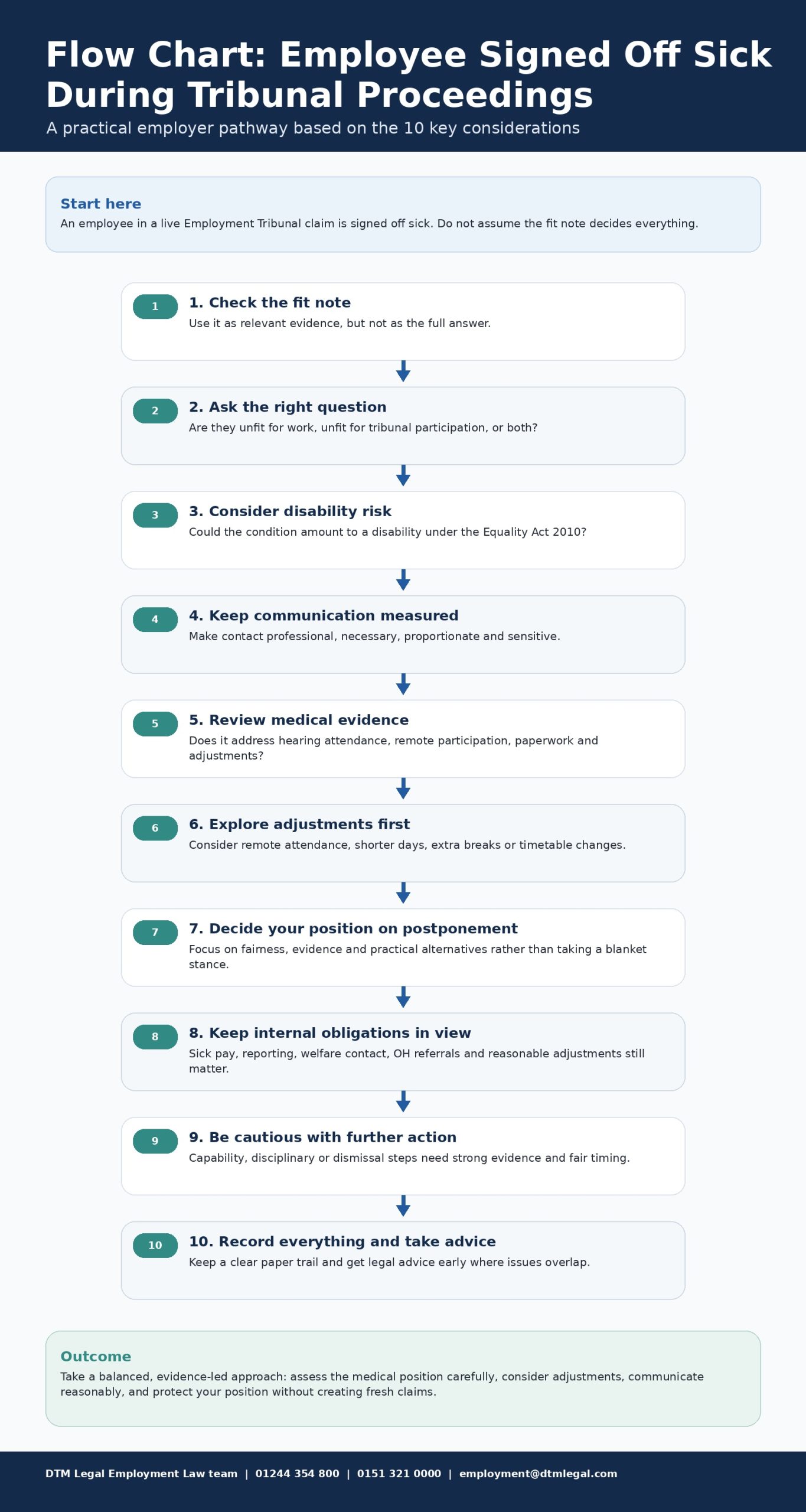


A recent BBC report highlighted growing concern around the increasing number of fit notes being issued by GPs. That sits against wider NHS and government guidance confirming that fit notes are commonly used once an employee has been absent for more than 7 days, and that sickness absence, workplace adjustments and tribunal participation all need to be handled carefully by employers.
Employee signed off sick during tribunal proceedings: what should employers consider?
When an employee brings an Employment Tribunal claim, matters can quickly become more complicated if they are also signed off sick. In some cases, the absence may be short-term and relatively straightforward. In others, it may be linked to stress, mental health, an underlying disability, or the very issues that gave rise to the claim in the first place.
For employers, this can create a difficult balance. On the one hand, you will want to defend the claim robustly and keep the process moving. On the other, a sick note should not be dismissed as a tactical step, and a heavy-handed approach can increase legal risk rather than reduce it.
-
Do not assume the fit note answers every tribunal question
A fit note may confirm that an employee is not fit for work, or that they may be fit for work with adjustments. However, that does not automatically mean they are unable to take part in tribunal proceedings.
This distinction is important.
An employee may be unfit to carry out their role but still capable of reviewing documents, attending a preliminary hearing, giving instructions to their representative, or participating in a final hearing with adjustments. Equally, there will be cases where their health genuinely affects their ability to engage in the process.
Employers should therefore avoid jumping to conclusions either way. A fit note is relevant, but it is not always the whole picture.
-
Consider whether the sickness absence may amount to a disability
One of the first questions employers should ask is whether the employee’s condition could amount to a disability under the Equality Act 2010.
This is particularly important where the absence relates to stress, anxiety, depression, a long-term physical condition, or another health issue with a substantial impact on day-to-day activities. If disability is in play, the employer’s obligations may extend beyond ordinary sickness absence management and into the duty to make reasonable adjustments.
That matters not only in the workplace, but also in the way the employer approaches the litigation itself. A failure to engage sensibly with health-related issues during the tribunal process can feed into discrimination allegations, particularly where the employee says the employer ignored medical evidence, applied pressure unfairly, or failed to adjust its approach.
-
Keep communication measured and reasonable
It is usually sensible to maintain contact with an employee who is off sick, including during litigation. However, the tone, frequency and purpose of that communication matters.
Employers should take care to ensure that contact is:
- professional;
- necessary;
- proportionate; and
- sensitive to the employee’s health condition.
Employers should keep communications clear, concise and focused on what is genuinely needed, with reasonable deadlines and, where appropriate, communicate through a representative.
-
Be careful when seeking medical evidence
If there is genuine uncertainty about the employee’s ability to participate in the tribunal process, further medical evidence may be needed.
Employers should consider whether it is appropriate to request clearer evidence on specific points, such as:
- whether the employee is fit to attend a hearing;
- whether they can participate remotely;
- whether they can deal with paperwork;
- whether shorter hearing days or regular breaks would assist; and
- when they may be well enough to take part.
This is particularly relevant because tribunal guidance makes clear that medical evidence for a postponement request should address fitness to attend the hearing itself, not just fitness for work.
-
Think carefully before opposing a postponement
A common issue is whether the employer should oppose an application to postpone a hearing because the employee is off sick.
There is no single right answer. Much will depend on the facts, including:
- the nature of the illness;
- the medical evidence available;
- whether the employee has legal representation;
- the stage of the proceedings;
- whether adjustments could allow the hearing to proceed; and
- the prejudice to each party if the case is delayed.
An employer may have legitimate grounds to oppose a postponement, particularly where the evidence is vague, late, or does not address the employee’s ability to take part in the hearing. However, a blanket refusal to accommodate a genuine health issue can be risky.
The better approach is usually to focus on fairness and practicality. For example, could the hearing proceed remotely? Could the employee give evidence on a shorter day? Could the timetable be adjusted rather than vacated entirely?
-
Explore adjustments before taking an adversarial position
If the employee’s health condition is affecting their ability to participate, employers should consider whether practical adjustments could help the process continue.
Depending on the circumstances, that might include:
- remote attendance;
- later start times;
- more frequent breaks;
- shorter hearing days;
- adjusting the order of witnesses;
- allowing questions to be handled more carefully; or
- agreeing extensions for document-related steps.
Tribunal users may themselves be entitled to reasonable adjustments from HMCTS, and it is often sensible for employers to show they have engaged constructively with that issue rather than simply insisting the case proceeds unchanged.
-
Do not lose sight of internal obligations
Where tribunal proceedings are underway, employers can sometimes become so focused on the claim that they neglect ongoing employment obligations.
If the individual remains employed, employers should still consider matters such as:
- sick pay entitlement;
- sickness reporting procedures;
- welfare contact;
- occupational health referrals where appropriate;
- reasonable adjustments;
- grievance or disciplinary processes; and
- any ongoing duty of trust and confidence.
In other words, the existence of tribunal proceedings does not suspend the employment relationship. Mishandling the employee’s absence while the claim is live can create fresh disputes and potentially expand the claim.
-
Be cautious with capability or disciplinary action
If an employee is signed off sick during tribunal proceedings, employers should be especially careful before starting or continuing a capability, disciplinary or dismissal process.
That does not mean such action is never appropriate. However, timing and evidence are critical. An employer should be able to show that any steps taken were for legitimate reasons, supported by evidence, and handled fairly. If the employee has raised concerns about discrimination, whistleblowing or other protected issues, the risks become even greater.
-
Keep a clear paper trail
Good documentation is often decisive.
Employers should keep accurate records of:
- fit notes and medical evidence received;
- requests for further information and why they were made;
- discussions about adjustments;
- reasons for agreeing or opposing postponements;
- internal decision-making; and
- steps taken to manage the employee’s absence fairly.
A well-kept paper trail can help demonstrate that the employer acted reasonably, took health concerns seriously and made decisions based on evidence rather than assumption.
-
Take advice early where the issues overlap
Cases involving sickness absence during tribunal proceedings often become more complex because several issues overlap at once. For example:
- ordinary unfair dismissal principles;
- disability discrimination;
- failure to make reasonable adjustments;
- victimisation;
- procedural fairness; and
- case management strategy.
That is why early legal advice is often valuable.
A practical and balanced approach
When an employee is signed off sick during the tribunal process, employers should resist the urge to treat the fit note as either conclusive proof or a mere litigation tactic.
The safest course is usually a balanced one: assess the medical position carefully, distinguish between being unfit for work and unfit for tribunal participation, consider adjustments, communicate reasonably, and keep a clear record of decisions made.
How DTM Legal can help
If your business is dealing with an employment tribunal claim involving sickness absence, stress-related absence, or questions around an employee’s ability to participate in proceedings, it is important to take advice early. A measured and legally informed approach can help you manage the tribunal process fairly while reducing the risk of further claims.
At DTM Legal, our Employment Law team advises employers on the full range of workplace disputes, including tribunal claims, sickness absence issues, discrimination concerns and reasonable adjustments. We can support you in assessing risk, responding to medical evidence, managing communications appropriately and protecting your position throughout proceedings.
To speak to a member of our Employment Law team, call 01244 354 800 or 0151 321 0000, or email employment@dtmlegal.com.